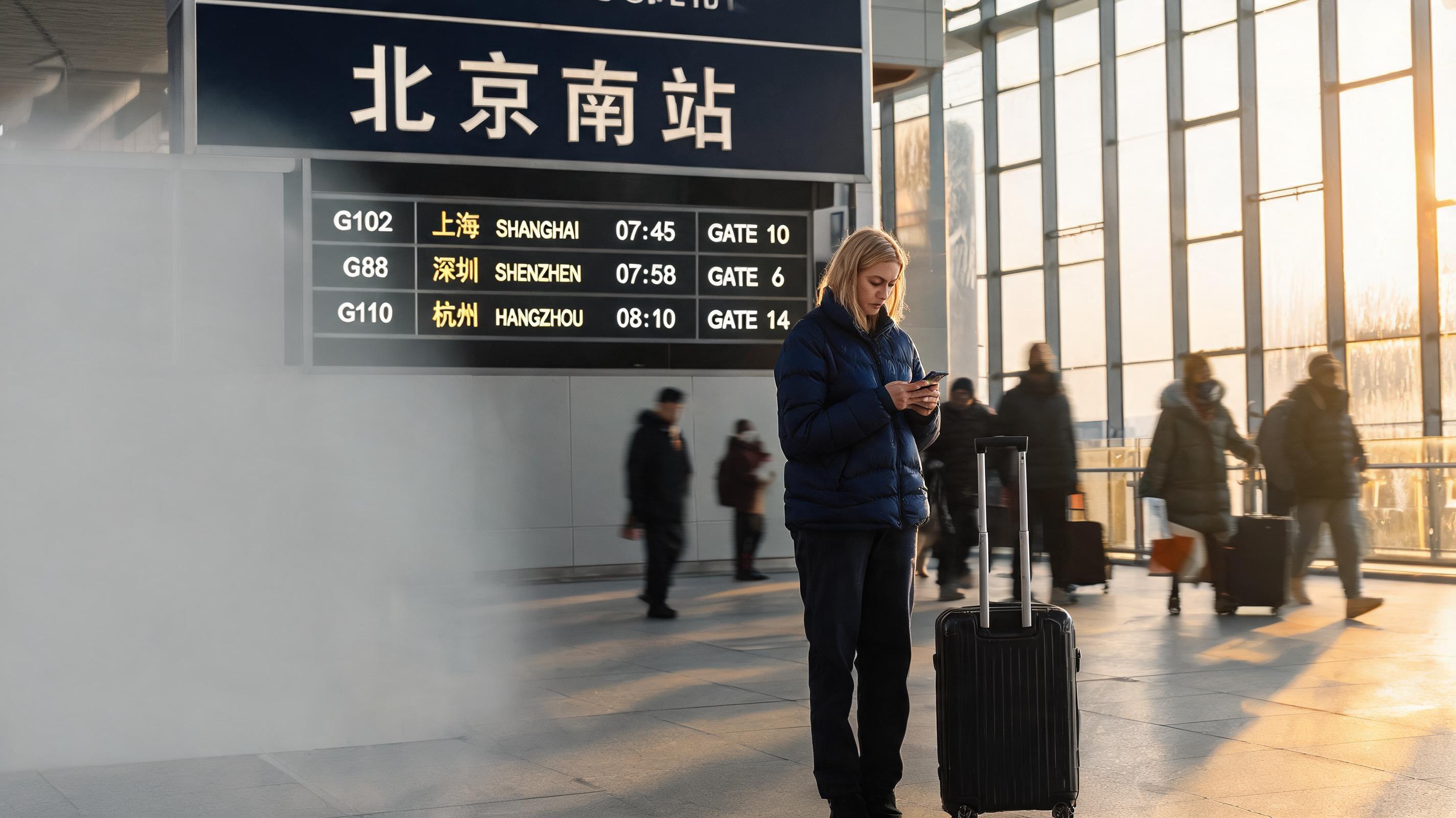
Beijing Shanghai High Speed Train: Beijing to Shanghai: High-Speed Train vs Flight (2026 Guide)
You booked your first China trip, saw the two-hour flight time between Beijing and Shanghai, and assumed flying was the obvious choice. Then you tried to book the alternative — a train ticket on the official 12306 site — and hit a wall: the passport verification kept failing, foreign cards got rejected, and English documentation was thin. Meanwhile, other travelers told you the beijing shanghai high speed train actually beats flying door-to-door. So what's the real answer? Below is a practical breakdown based on how foreign visitors actually navigate this route in 2026 — including the booking pitfalls nobody warns you about, the class you should actually pick, and whether that romantic overnight sleeper is worth it.
How Long Does the Beijing to Shanghai High-Speed Train Take?
The fastest G-class trains cover the 1,318 km run in about 4 hours 28 minutes, city center to city center. Slower G-services stop more often and take 5 to 6 hours; the older D-class trains push closer to 7 hours for a small price saving that rarely justifies the extra time.
Which service to book
- G-class (Gaotie / Fuxing): 4h28m–5h30m. This is what you want.
- D-class: 6h30m–7h. Cheaper by roughly ¥100–150 but slow.
- Z/T-class overnight: 10–13 hours. Legacy sleepers, discussed below.
The flagship non-stop Fuxing services between Beijing South and Shanghai Hongqiao are the reason the beijing to shanghai train time can undercut flying once you factor in airport transit.
Is It Better to Fly or Take the High-Speed Train?
For most travelers, the train wins. A shanghai to beijing flight is scheduled at roughly 2h15m, but that number lies. Once you add the metro or taxi to Pudong or Daxing, check-in cutoffs, security, boarding, and China's chronic domestic flight delays, your real door-to-door time is 5.5 to 7 hours.
The consensus from firsthand accounts: the beijing shanghai high speed train reliably beats flying on total time, punctuality, and stress — unless your hotel is directly next to the airport.
When flying still makes sense
- You have a tight international connection through PEK or PVG.
- You booked a deep-discount fare well under train pricing.
- You're headed somewhere not near either downtown station.
When the train is clearly better
- You value on-time performance (Chinese high-speed rail is famously punctual).
- Your hotel is central in either city.
- You have luggage you'd rather not check.
- You want to actually see the countryside instead of clouds.
How Much Does a Beijing to Shanghai High-Speed Train Ticket Cost?
Standard 2026 fares on G-trains, in RMB:
| Class | Price (approx.) | What you get |
|---|---|---|
| Second Class | ¥553–¥650 | 3+2 seating, adequate legroom, power outlet |
| First Class | ¥933–¥1,050 | 2+2 seating, wider recline, quieter car |
| Business Class | ¥1,748–¥2,300 | Near-lie-flat seat, meal, station lounge access |
For comparison, a same-day economy shanghai to beijing flight typically runs ¥700–¥1,400 before you add ground transport on both ends.
Which class is actually worth it
First class is the sweet spot for most travelers: significantly quieter, wider seats, and often only ¥300–¥400 more than second. Business class on the Fuxing is the surprise value pick — frequent travelers repeatedly note that it costs less than business class on the equivalent flight while delivering a lounge, a meal, and a seat that reclines nearly flat for the 4.5-hour ride.
How Foreigners Actually Book Tickets (Without Losing an Afternoon)
The train from beijing to shanghai official website is 12306.cn, and it technically accepts foreign passports — but travelers repeatedly hit dead ends on payment (foreign Visa/Mastercard rejections), SMS verification (Chinese phone number required for full functionality), and passport format validation. It works for some, fails for many.
The reliable workaround
Use an English-language third-party agent such as Trip.com or China Highlights. They accept foreign cards, link your passport to the booking, and issue a QR e-ticket. You pay a small markup (¥20–¥50 per ticket) — worth it to avoid the 12306 rabbit hole.
At the station
- Bring the exact passport you booked with. The gate scans your passport chip, not a paper ticket.
- If the automated turnstile rejects your passport (common with older passports or non-Latin name fields), go to the manned lane on the far side. Staff manually type your passport number and wave you through in seconds.
- Screenshot your e-ticket confirmation and passport info page before entering the station. Station Wi-Fi is unreliable and you don't want to be searching your inbox at the gate.
Beijing Shanghai High Speed Train Schedule: When to Depart
Non-stop and near-non-stop G-trains run roughly every 30–60 minutes from around 06:30 to 19:00 in both directions. The most useful anchors:
- Beijing South → Shanghai Hongqiao: earliest ~06:26, latest ~19:00.
- Shanghai Hongqiao → Beijing South: earliest ~06:26, latest ~19:00.
Friday evening and Sunday afternoon departures sell out days ahead. Book 7+ days in advance for any weekend travel.
Common Myths About the Beijing–Shanghai Route
Myth 1: Flying is faster because it's only two hours in the air
Real traveler reports consistently show door-to-door flight time hits 5.5–7 hours once you add airport transit, 90-minute check-in cutoffs, security, and Chinese domestic aviation delays. The 4h28m train, which drops you in the city center, wins.
Myth 2: You can just show up and buy a ticket at the station
Popular departures — early morning, Friday evenings, Sunday afternoons — sell out. Foreign travelers repeatedly note that self-service kiosks reject non-Chinese IDs, meaning you queue at a manned counter with your passport, adding 20–40 minutes. Book online in advance.
Myth 3: The overnight sleeper saves a hotel night and is a great budget hack
Foreign travelers who tried the sleeper found it slower than expected (10–13 hours), with sleep quality below what most first-time visitors imagine. The newer high-speed sleeper service exists on some routes but has limited availability and books out fast. For most travelers, the day G-train plus a ¥300 hotel is faster, cheaper, and more restful.
Myth 4: Business class is a splurge only worth it for status miles
Not on this route. Business class on the Fuxing includes lounge access, a served meal, and a seat that reclines nearly flat — often at a lower price than a business-class domestic flight, with the added win of arriving downtown.
Real-World Hacks From Foreign Travelers
Hack 1: Split your classes for the round trip
Book business class one direction and second class the other. You get the lounge-and-meal experience once, keep total cost reasonable, and honestly appreciate second class more after seeing what business feels like.
Hack 2: Choose Beijing South ↔ Shanghai Hongqiao G-trains specifically
Filter for G-class only. The price gap versus D-trains is small (¥100–¥150), but you save 1–2 hours. Sorting by cheapest first is the classic first-timer trap.
Hack 3: If landing at PVG, cross the city to Hongqiao
Pudong (PVG) does not connect to the high-speed network for Beijing service. You need Shanghai Hongqiao Railway Station, co-located with Hongqiao Airport. Metro Line 2 is the direct link but takes ~90 minutes with luggage. Build in at least 2 hours between your international landing and train departure, more if you haven't cleared Chinese immigration before.
Hack 4: Link your passport at booking so the gate scanner works
When booking through a third-party agent, enter your passport number exactly as printed. This lets you scan through the automatic gate with your passport instead of queueing for manual verification.
Hack 5: Screenshot everything before you enter the station
E-ticket confirmation number, passport photo page, and booked seat. If the scanner fails, staff need to type your passport number manually — having it on screen speeds this up dramatically.
Bottom Line
For a 4.5-hour journey between two of China's most connected cities, the answer is straightforward:
- Take the G-class high-speed train between Beijing South and Shanghai Hongqiao. It beats flying door-to-door for time, punctuality, and stress.
- Book through an English third-party agent rather than fighting the official 12306 site with a foreign passport and card.
- Consider business class one way — it costs less than a business-class flight and turns the ride into part of the trip.
Related Articles
- Classic Beijing, Xi'an, Shanghai First-Time Itinerary
- How Foreigners Actually Pay in China (2026)
- Classic Beijing-Xi'an-Shanghai Two Week Itinerary
- Shanghai Shopping and Bar Restaurant Guide
- Two-Month Solo Backpacking Across China
Key Takeaways
- The beijing shanghai high speed train takes ~4h28m on non-stop G-services and typically beats flying on total door-to-door time.
- Standard 2026 fares: ¥553 second class, ¥933 first class, ¥1,748+ business class.
- Book via Trip.com or another English agent — the official 12306 site frequently fails on foreign cards and passport verification.
- Skip the legacy overnight sleeper unless you specifically want the experience; a day G-train plus a hotel is faster and more restful.
- Screenshot your e-ticket and passport before entering the station in case the automatic gates reject your passport scan.
Tags
About the Author
The author has lived and traveled extensively in China for 5+ years, specializing in practical advice for first-time foreign visitors navigating the Chinese payment and transportation ecosystems. Insights are synthesized from hundreds of firsthand traveler reports.